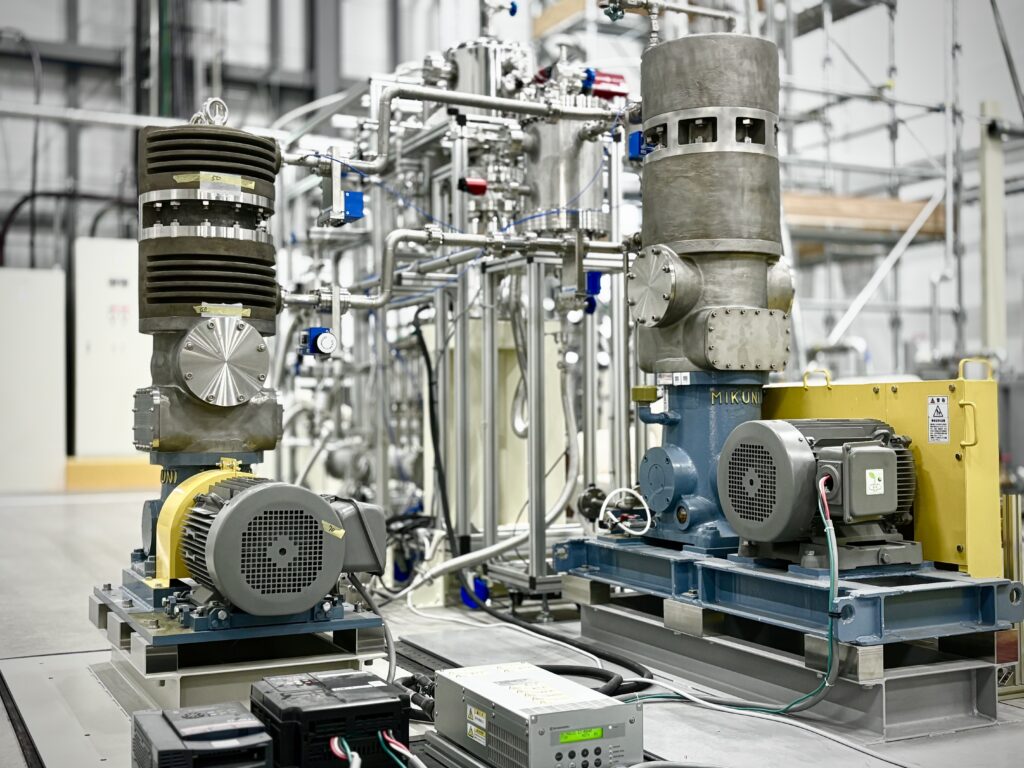
Kyoto Fusioneering Awarded Contract by QST to Develop Tritium Extraction and Accountancy System Prototypes for ITER Test Blanket System
Domestic validation program to advance key fuel cycle technologies ahead of ITER deployment and future fusion power demonstration
Kyoto Fusioneering (KF) has been awarded a contract by the National Institutes for Quantum Science and Technology (QST) to develop prototypes of the Tritium Extraction System (TES) and Tritium Accountancy System (TAS), critical components of the Test Blanket System (TBS) planned for ITER, the international fusion experiment under construction in southern France.
This program is designed to identify manufacturing risks and strengthen technical readiness in Japan prior to full-scale deployment at ITER. Drawing on its expertise in tritium handling technologies, KF will design and fabricate the prototypes and carry out installation at the Blanket Engineering Test Building of QST’s Rokkasho Fusion Energy Research Institute in Aomori Prefecture. The systems will subsequently be used for testing and validation in support of the Test Blanket Module (TBM) program within the ITER project.
Enabling Fusion Fuel Self-Sufficiency: TES and TAS
The TBM program is a distinctive framework within ITER in which participating parties contribute independently developed technologies for comparative evaluation and validation. The systems developed under this program incorporate technologies uniquely developed in Japan.
The Test Blanket System, comprising the TBM and associated auxiliary subsystems, is designed to demonstrate the in-reactor production and recovery of tritium, a prerequisite for achieving fuel self-sufficiency in future fusion power plants.
The TES and TAS, for which KF is developing the prototypes, are central to this objective. Both systems will undergo domestic validation using Japan’s own design and operational approaches prior to deployment at ITER.
In parallel with hardware development, KF will develop a remote-control program using the CODAC Core System, ITER’s standard control platform. This will enable validation in an environment equivalent to ITER operations and support the advancement of remote operation technologies for future fusion plants.
Tritium Extraction System (TES)
A system that extracts tritium generated in the blanket together with helium gas, and separates and recovers it through a series of processing units. These include drying columns to remove moisture and impurities and palladium diffusers that selectively permeate tritium. The TES plays a critical role in enabling the tritium fuel cycle in fusion energy plants.
Tritium Accountancy System (TAS)
A system that enables precise measurement and management of recovered tritium, providing essential functionality for fuel management and safety assurance in fusion power plants.
Advancing ITER Through Domestic Validation
As Japan’s core institution for fusion energy R&D, QST is advancing research in blanket engineering and tritium handling technologies at its Rokkasho Fusion Energy Research Institute, with a view toward ITER and future fusion power demonstration.
KF specializes in the integrated engineering of systems required for fusion energy plants and has, since its founding, focused on the development of breeding blankets, tritium fuel cycles, and related systems.
UNITY-2, the world’s first integrated tritium fuel cycle test facility currently under construction in Canada by Fusion Fuel Cycles (FFC), a joint venture between KF and Canadian Nuclear Laboratories (CNL), incorporates advanced tritium processing and accountancy technologies. Expertise gained through this program will directly support KF’s contribution to the TBM program. KF will advance the design and fabrication of Japan-developed systems for the TBM program, while identifying manufacturing risks and strengthening technical readiness, contributing to the steady advancement of ITER.
Comment from Kiyoshi Seko, President and COO of Kyoto Fusioneering
“We are honored to contribute to the TBM program, a key element of ITER dedicated to demonstrating the viability of fusion energy through Japan’s own technologies. Since our founding, we have focused on developing the engineering capabilities required for fusion energy plants, including blankets, fuel cycles, and related systems. Through this project, we aim to translate these capabilities into tangible progress toward the success of ITER and future power generation demonstration. Building on QST’s world-leading solid breeder water-cooled blanket technology, we will continue to contribute as a private-sector partner and advance fusion energy through public-private collaboration.”