Minister of State for Science and Technology Policy Toshiharu Furukawa Visits Kyoto Fusioneering’s Tokyo Headquarters
Minister tours KF’s fuel cycle system and gyrotron development sites and discusses the industrialization of fusion energy
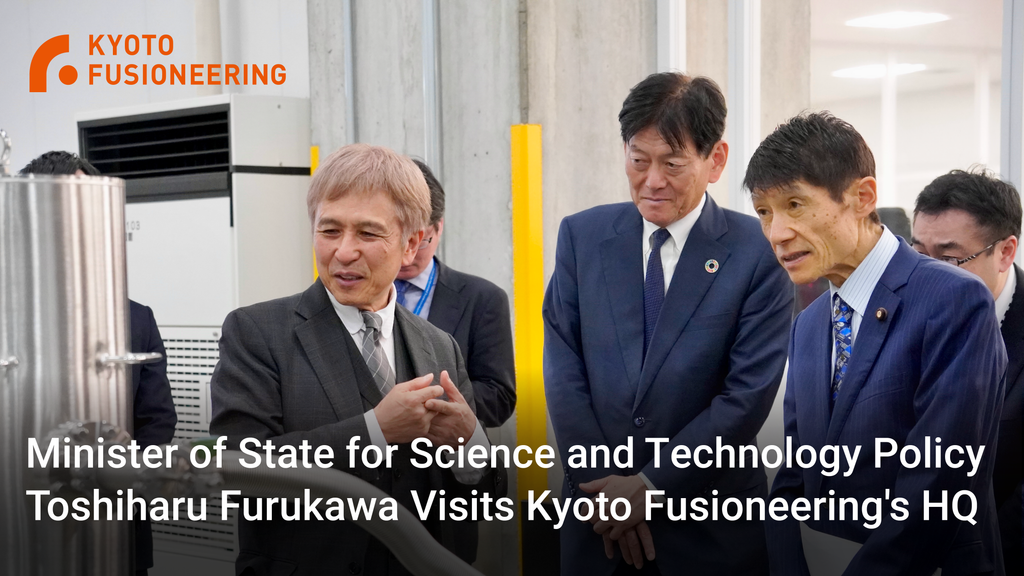
TOKYO, October 22, 2026 — Kyoto Fusioneering Ltd. (KF) welcomed Toshiharu Furukawa, Minister of State for Science and Technology Policy, to the technology development site at its Tokyo headquarters on October 22, 2026.
The Minister toured the sites where KF develops its fuel cycle systems, gyrotrons and other technologies, and discussed KF’s efforts toward the industrialization of fusion energy with KF’s management. During the discussion, the Minister noted that KF already has a track record of sales overseas and expressed his intention to support its efforts.
Background of the Visit
Fusion energy is a growth industry, with some estimates putting the global market at approximately JPY 120 trillion by 2040 (Cabinet Office, Science, Technology and Innovation Promotion Secretariat, materials from Task Force on Basic Approaches for Social Implementation of Fusion Energy, January 2026), and it is positioned as one of the key pillars of Japan’s national strategy.
This was the Minister’s first visit to a fusion energy development site since taking office in September 2026. It gave the minister responsible for science and technology policy an opportunity to see firsthand a private-sector development site moving from research and development toward industrialization, in a field the government is prioritizing.
Overview of the Visit
- Date: October 22, 2026
- Location: Kyoto Fusioneering Ltd., Tokyo Headquarters
- Visitor: Toshiharu Furukawa, Minister of State for Science and Technology Policy
- KF attendees: Satoshi Konishi, Representative Director, Chairman and CEO, and others
- Program: tour of facilities and equipment; discussion with KF’s management
About KF
KF develops the infrastructure indispensable to realizing fusion energy — including plasma heating, tritium fuel cycle, and tritium-breeding blanket and thermal cycle systems — and takes an integrated approach to fusion energy engineering and commercialization.
KF is currently advancing the UNITY Program, an integrated demonstration program across three sites in Japan, Canada and the United States. UNITY-1, KF’s integrated breeding blanket and thermal cycle test facility at the Kyoto Research Center (Kumiyama, Kyoto), links heat extraction from the blanket through to power conversion in a single test loop, without triggering an actual fusion reaction. UNITY-2 in Canada focuses on the fuel cycle, and UNITY-3 in Tennessee, U.S., demonstrates breeding blanket technology in collaboration with Oak Ridge National Laboratory (ORNL).
Comments
Toshiharu Furukawa, Minister of State for Science and Technology Policy
“Fusion energy is one of the national strategic technologies the government is prioritizing, for both energy security and economic growth. Today I saw a site where private-sector technology and talent are driving development toward a world-first power generation demonstration in the 2030s. To carry the results of research and development through to industrialization, I believe it is important for the government to support challenges like this from the private sector.
It is very encouraging that Kyoto Fusioneering already has a track record of sales overseas. To carry the results of research and development through to industrialization, the government will firmly support these efforts.”
Satoshi Konishi, Representative Director, Chairman and CEO, Kyoto Fusioneering Ltd.
“We were pleased to show Minister Furukawa, who oversees science and technology policy, the site where KF carries out its development. Fusion energy cannot be realized with plasma devices alone. It also requires producing fuel, extracting heat and converting it into electricity. We believe that building each of these systems with Japan’s technology and industrial strength is the path to a power generation demonstration in the 2030s and to industrialization beyond it.
Incorporating the insights shared today, we will further accelerate our development efforts with our partners in Japan and around the world toward the earliest possible deployment of fusion energy.”