
Technology
Turning Fusion Science into
Practical Engineering
We do not try to build everything ourselves. We bring the capabilities of Japan manufacturing industry to bear on fusion, and turn them into systems and equipment a power plant can use.
That approach has not changed since we were founded: translate scientific knowledge into practical engineering, bridge research and manufacturing, and integrate individual technologies into complete systems.
Co-founder Satoshi Konishi spent a research career watching the depth of Japanese manufacturing go unused by fusion. Converting that capacity into industrial supply for the fusion industry has been our approach ever since.
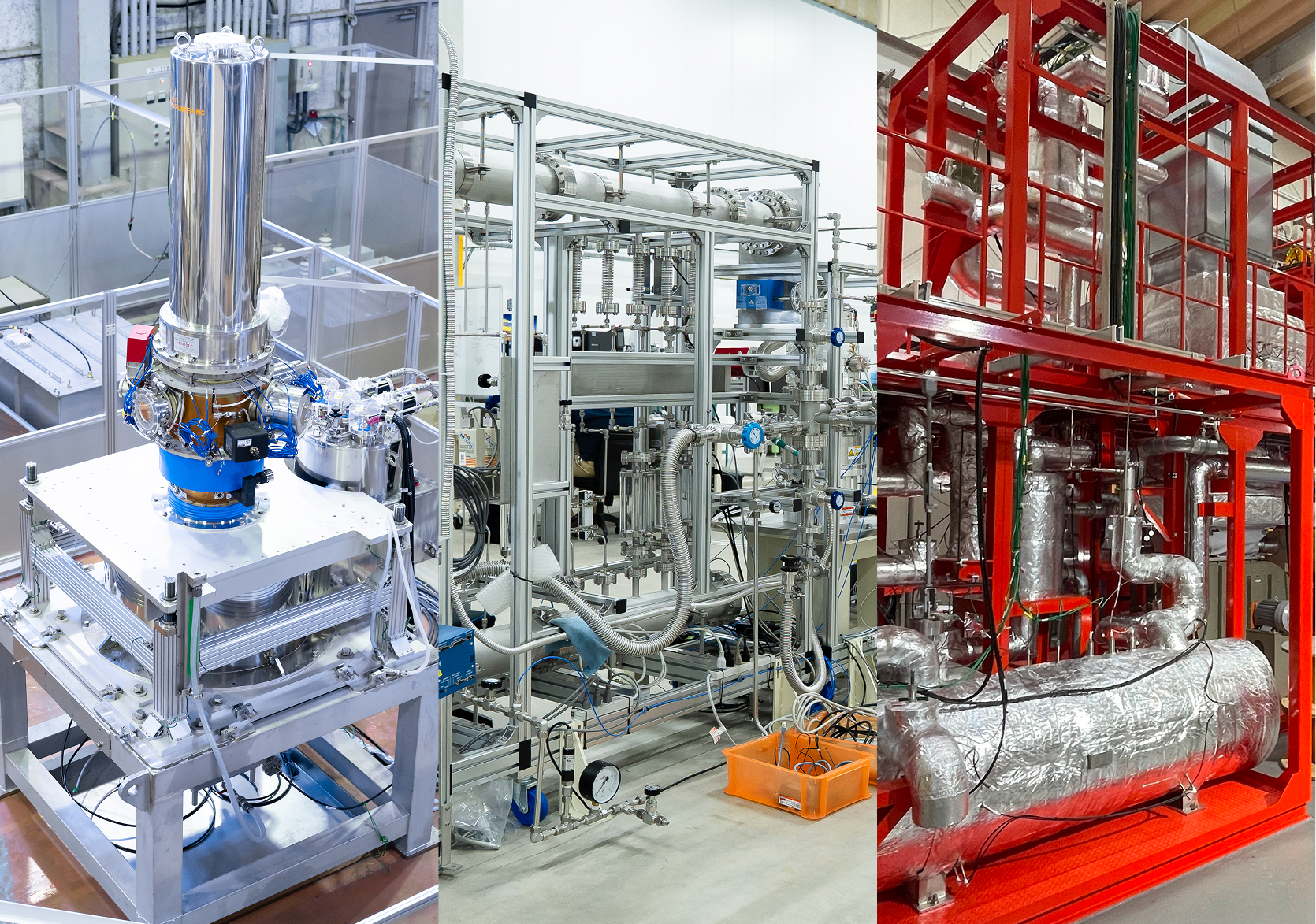
Fusion Plant
Key Technologies for Commercial Fusion Power Plants
Kyoto Fusioneering develops, designs and integrates the key systems that make up a commercial fusion power plant.
These technologies do not operate in isolation. By working together as an integrated system, they enable the plant to function as a complete power-generation facility.
Fusion Energy Reactor and Our Areas of Expertise
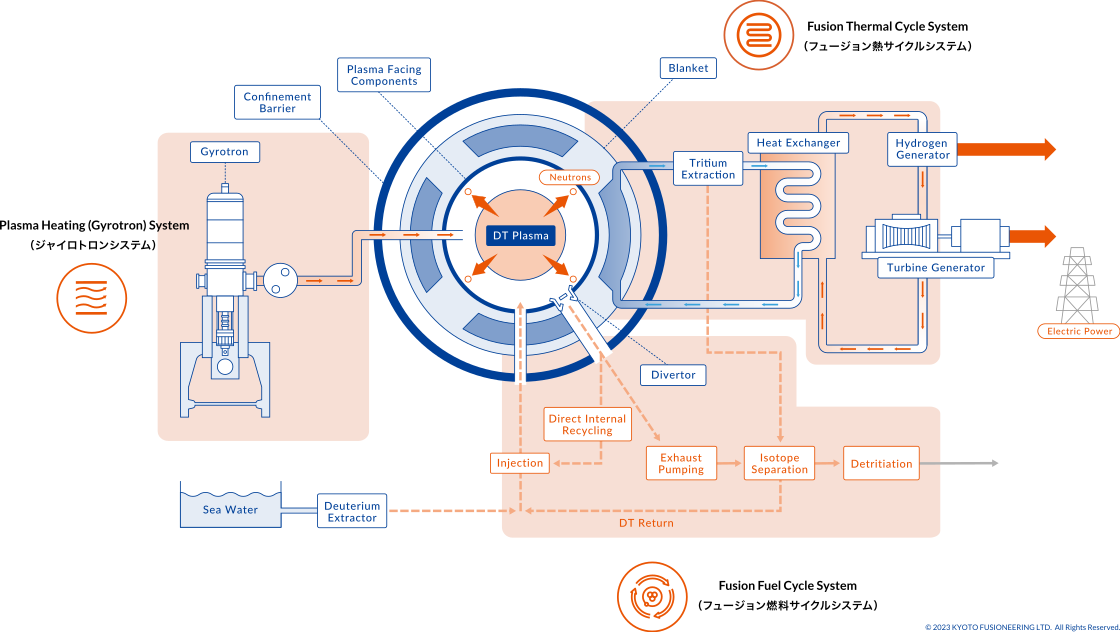
Technology 01
Plasma Heating System
Magnetic confinement devices need external heating to reach fusion temperatures and hold the plasma stable. Kyoto Fusioneering supplies that heating as a complete system rather than as a component: the gyrotron itself, plus the superconducting magnet, matching optics, high-voltage power supply, transmission lines, and cooling and control infrastructure required to run it.
That distinction matters commercially. Integrating high-power, high-frequency components from several vendors is one of the largest schedule and cost risks a fusion program takes on. We remove it by delivering the system pre-validated.
Our engineering team includes people who developed the gyrotrons used on the world’s largest fusion programs — including those developed at the National Institutes of Quantum Science and Technology (QST) for ITER — and that work continues here — toward higher frequencies, longer continuous operation, and the manufacturing and quality systems commercial plants will require.
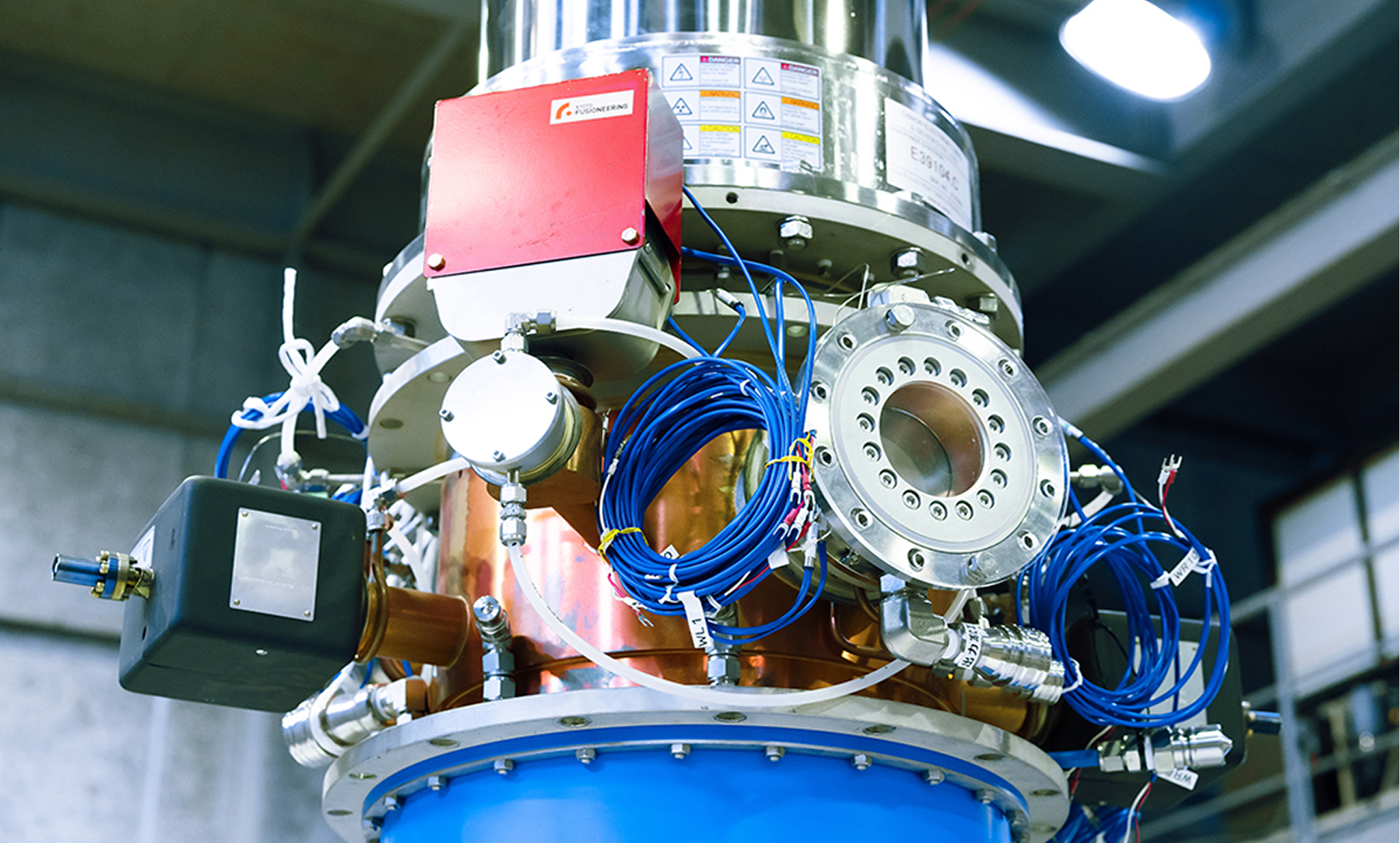
Technical Advantages
- Gyrotrons across seven frequencies from 28 GHz to 236 GHz, including multi-frequency tubes that let one system serve several operating regimes. (236 GHz under development.)
- Delivered to public fusion programs and private developers internationally, including UKAEA and General Atomics.
- Developed jointly with major Japanese technology and manufacturing companies.
- Applicable beyond fusion, in industries requiring high-power millimeter-wave sources.
Technology 02
Fusion Fuel Cycle System
Every fusion concept burning deuterium and tritium needs a fuel cycle, and the reason is arithmetic: only a small fraction of the fuel injected into a device is actually burned. The rest has to be pumped out, cleaned of impurities, separated by isotope, stored, and returned to the reaction — continuously, with almost nothing lost, and inside the tritium inventory and release limits a licensed plant must meet.
Kyoto Fusioneering develops the technologies across that whole loop: vacuum pumping, direct internal recycling, fuel cleanup, isotope separation, storage, detritiation, and tritium accountancy. Through Fusion Fuel Cycles, our joint venture with Canadian Nuclear Laboratories, we are bringing them together in UNITY-2 at Chalk River and out to the market.
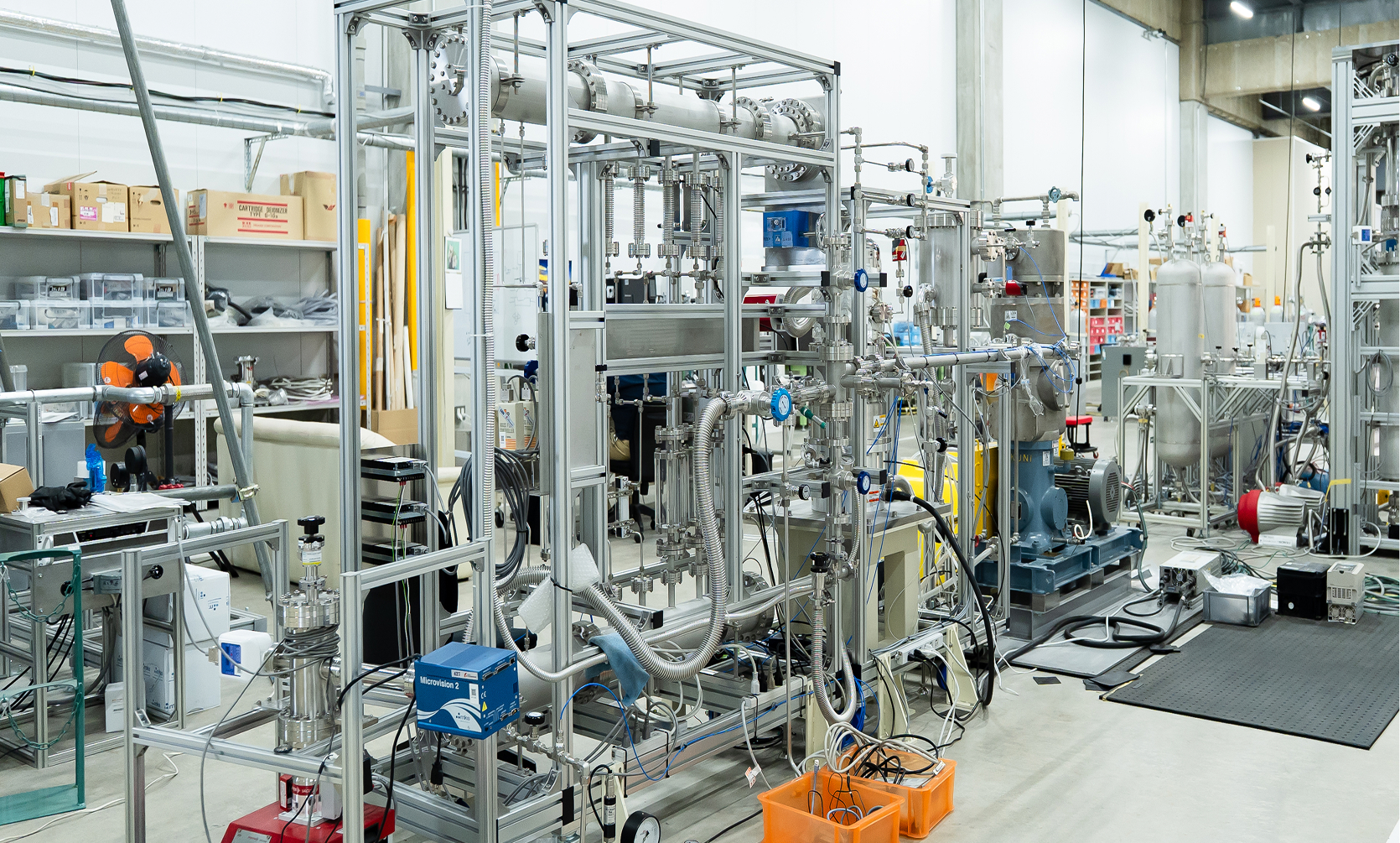
Technical Advantages
- Technologies and equipment to enable efficient tritium extraction from liquid breeder systems.
- Plasma exhaust systems — divertor systems, vacuum pumping, and direct internal recycling — with separation technologies for impurity removal and isotope separation, to sustain continuous burn through efficient tritium recovery.
- Optimization of fusion fuel cycle systems and investigation of cost-competitive designs.
Technology 03
Fusion Blanket and Thermal Cycle System
Whatever confines the plasma, every fusion power plant has to do two things with its neutrons: capture their energy as heat, and use them to breed the tritium the plant consumes. The breeding blanket does both. The thermal cycle then carries that heat to power generation and industrial use.
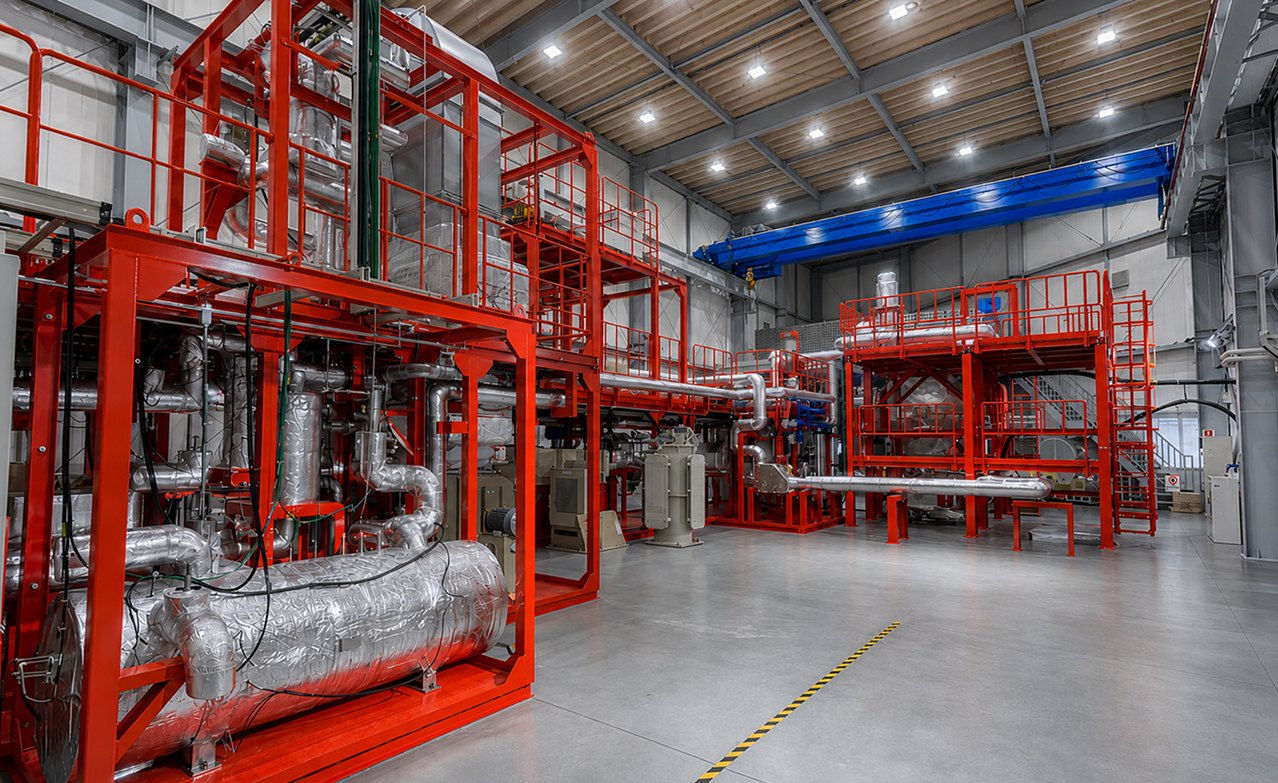
Both demand materials that survive high-energy neutron irradiation and extreme temperatures, and plant designs that move heat efficiently enough to generate power economically. Kyoto Fusioneering develops the blanket, the heat utilization system, and the plant design as one, and proves them in UNITY-1 today and, with Oak Ridge National Laboratory, in UNITY-3.
Technical Advantages
- Development of advanced materials including SiC composites, heat-resistant to 1000°C and low-activation.
- Advanced blankets with heat recovery and tritium breeding capabilities at high temperatures, across liquid metal and molten salt systems.
- Advanced heat exchangers and innovative power generation cycles using helium and other media.
- Exploration of hydrogen production using zero-carbon, high-temperature heat sources derived from fusion energy, and carbon fixation technology through the pyrolysis of biomass.