THE FUSION ERA – Bridging the Gap Between Design and Testing: Developing an In-House Gyrotron Simulation Code
One of the key technologies for making fusion energy a reality is the gyrotron system, which heats the plasma inside a fusion reactor. At Kyoto Fusioneering (KF), we’re working to identify bottlenecks limiting the performance of existing gyrotrons, so we can reliably build even better ones.
As part of this effort, our engineer Dr. Satoru Kobayashi developed an original simulation code that calculates the behavior of electron beams inside a gyrotron with both speed and precision.
Where the conventional method took several hours, this new code completes the same calculation in about five minutes, making it a powerful tool for closing the gap between design and real-world testing.
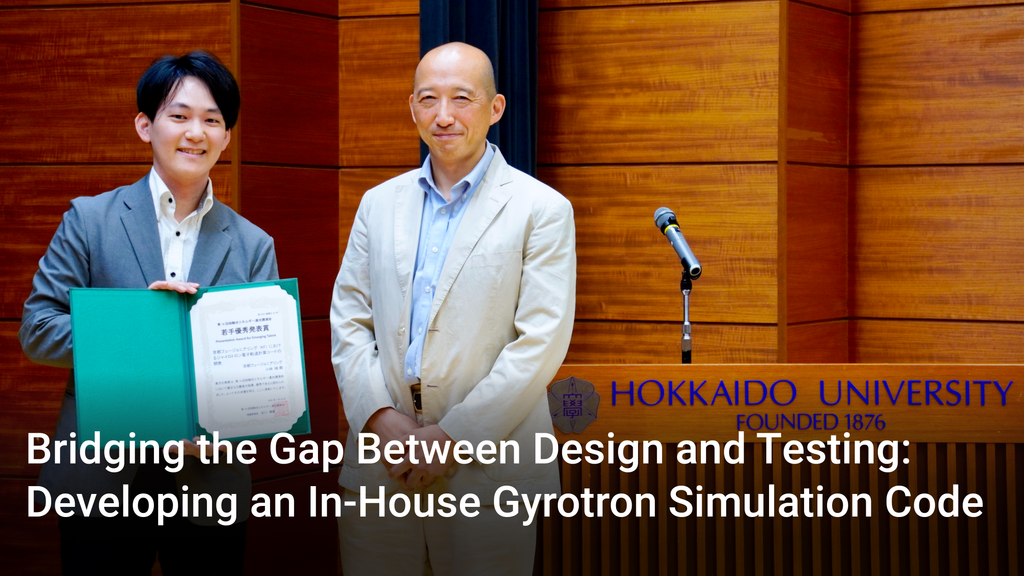
This work was presented as a poster at the “16th Joint Conference for Fusion Energy”, held at Hokkaido University over two days starting July 23, where Satoru received the Presentation Award for Emerging Talent.
In this blog, we sat down with Satoru to hear about the story behind the development, his thoughts on the award, and what’s next.
Can you tell us about your research topic, the “electron trajectory calculation code”?
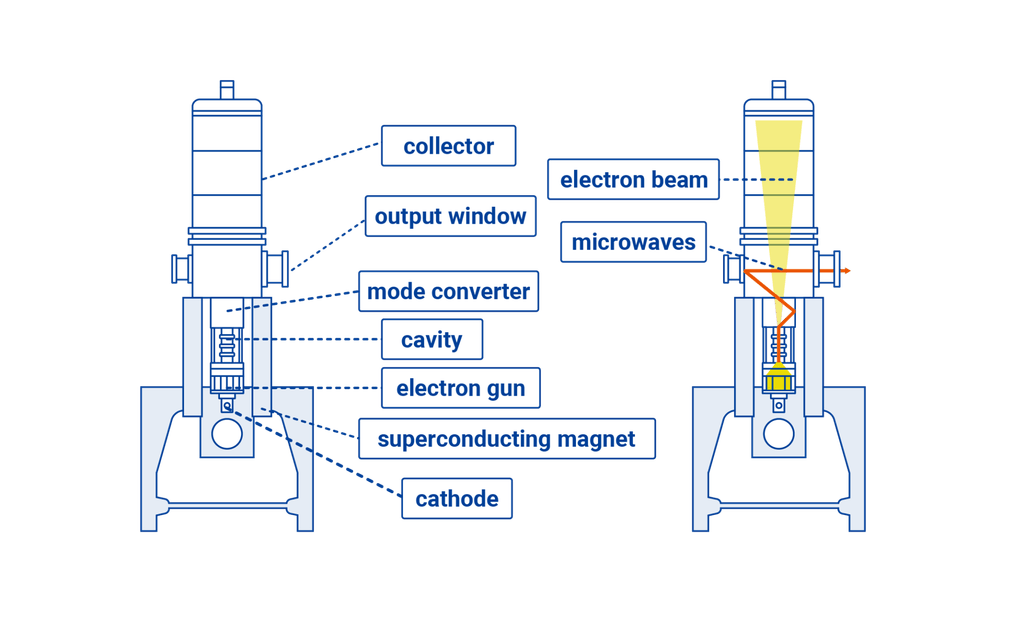
A gyrotron is like a microwave oven for the plasma inside a fusion reactor — it heats the plasma so fusion reactions can take place. Today’s gyrotrons can heat plasma at roughly 2,000 times the output of a household microwave (500 W), reaching 1 MW.
At KF, my main mission is to build on gyrotrons that already have strong international recognition for their heating performance and efficiency — developed mainly by Japanese research institutions — and make them even better, in a way we can reliably reproduce. To do that, we first need to quantitatively pin down the bottlenecks limiting existing gyrotrons’ performance.
Gyrotrons are complex machines that require strong magnetic fields, high voltage, and large currents. To push today’s 1 MW-class gyrotrons to higher output (1.5–2 MW down the road), we need to raise the electron beams voltage and current. But increasing the current strengthens what’s called the “space charge effect” electrons repelling one another — and that effect lowers the gyrotron’s efficiency.
Without an accurate way to calculate this effect, we simply can’t design for higher output. So I developed an original simulation code that can quickly and precisely calculate the electron beam’s behavior inside a gyrotron, space charge effect included.
What are the technical highlights of the simulation you developed?
The biggest highlight is combining speed and accuracy.
Inside a gyrotron, the electron beam goes through several stages — it’s generated, guided by a strong magnetic field, used to generate microwaves, and then partially recovered — so I felt we needed a program that could handle all of these processes together.
The Particle-In-Cell (PIC) method is the go-to approach for precisely calculating electron beam behavior, but it’s extremely time-consuming — simulating even part of a gyrotron can take around six hours. Fast commercial software exists too, but building an integrated program on top of it proved difficult.
With the program I built, we can now run a full electron-beam calculation for an entire gyrotron in about five minutes. Its real strength is solving the electron beam’s trajectory and the cavity’s microwave generation together, self-consistently — accounting for how each affects the other — all within a short time.
Two things made this possible.
First, making full use of excellent open-source libraries — though using them correctly meant carefully working through the documentation, which was honestly the hardest part.
Second, parallelizing the code to speed it up without changing the results, where I leaned heavily on today’s AI, in the form of large language models. Our internal IT team was incredibly supportive here, from hardware specs to security, in building an environment where we could actively put the latest AI tools to work.
By letting AI handle the implementation, debugging, and literature research, I could focus my own time on verifying whether the results were physically correct. Splitting the work between people and AI really pushed the development forward.
What are your honest thoughts on receiving this award?
Honestly, I was delighted. When I first joined the company, the team was still small, so I took on a lot of different roles, including commissioning gyrotron power supplies. Since then, colleagues with a range of expertise have joined and taken over the design and testing of gyrotron systems both in Japan and overseas, which has let me focus more recently on gyrotron R&D. Having the work I’ve been focused on recognized is a real source of encouragement.
For this presentation, I didn’t want to just talk about the program itself — I made sure to carefully examine the space charge effect, one of the main factors behind reduced gyrotron efficiency. Running an accurate simulation and comparing it against experimental data shows exactly where the gap between calculation and experiment lies, and what physical phenomena are lowering efficiency. I think it was that grounded, hands-on approach to the technology that got recognized.
The conference itself was full of energy — hundreds of people attended, and the poster session was so crowded it was hard to even walk through the aisles. I was asked to explain my poster many times, and feeling that level of interest firsthand really stuck with me.
How do you see this research being put to use going forward?
This simulation is already being used to explore operating conditions during the startup testing of newly built gyrotrons. The project started from a real problem — our test units weren’t reaching the oscillation efficiency we’d expected at the design stage — and closing that gap between design and experiment was the whole point. That’s also why speed mattered so much: if the calculation is slow, it’s much harder to meaningfully compare against experimental results.
Going forward, I want to keep improving the model’s accuracy against real operating data, use that to drive data-driven development of gyrotrons beyond 1 MW, and eventually build a system that can optimize gyrotron operation itself.
Is there anything you’d like to take on next?
Fusion energy is entering a phase where knowledge built up in academia needs to be industrialized, and international competitiveness is becoming essential. Even at this conference, the discussion went beyond individual academic topics to a bigger question: how do we industrialize this?
In that context, what I want to become is an engineer who can bridge multiple worlds. This research bridges experiment and calculation, since the code exists to close the gap between the two.
My science background, applied to the engineering-driven world of gyrotron development, is its own bridge between science and engineering.
Going forward, we’ll need to bridge academia and startups, and bridge Japan and the world — showcasing Japan’s manufacturing and technical strength on a global stage. I want to become an engineer and researcher who can build these bridges on an even bigger scale.
Developing gyrotrons that combine high output with high efficiency is one of the essential pieces on the path to fusion energy. The steady, hands-on work of engineers like Satoru is bringing that goal closer, one step at a time.
THE FUSION ERA: https://kyotofusioneering.com/news_category/blog
Interview with Satoru (as of February 2023): https://kyotofusioneering.com/news/2023/02/08/1165